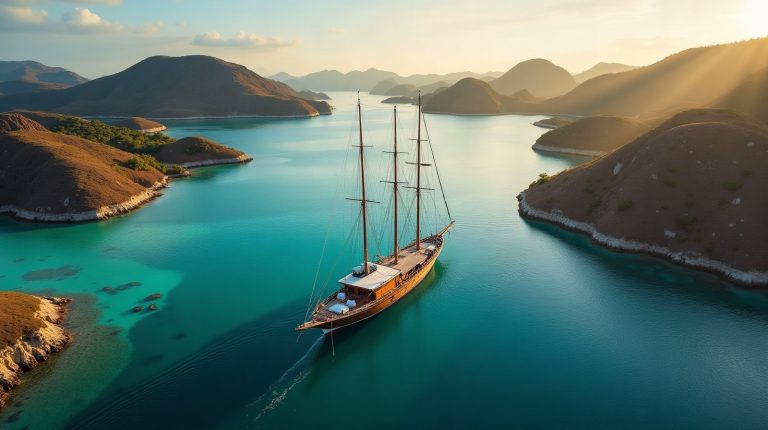
What is the Best Time to Sail Indonesia by Yacht?
- For Raja Ampat, the ideal season is reversed, running from October to April due to its distinct microclimate.
- The shoulder months of April-May and September-October offer a superb balance of excellent weather and fewer crowds.
- Transitional periods in March-April and September-November are perfect for Banda Sea crossings, targeting specific marine migrations.
The first light of dawn spills across the Flores Sea, turning the water from indigo to liquid gold. From the bow of a classic Phinisi schooner, the air is thick with the scent of salt and the distant, earthy aroma of volcanic islands. A question hangs in this perfect stillness, a question we field constantly from discerning travelers: when is the absolute best time to embark on this journey? The answer, much like the archipelago itself, is not a single point on a map but a magnificent, sprawling chart of possibilities. Navigating Indonesia’s 17,500 islands by private yacht is an exercise in precision timing, aligning your desires with the rhythm of the monsoons that have governed these waters for millennia.
Decoding Indonesia’s Dual Climates: A Tale of Two Monsoons
Understanding when to sail Indonesia begins with understanding its elemental forces: the monsoons. This is not a country with four distinct seasons; it is a vast equatorial expanse, stretching over 5,100 kilometers from Sabang to Merauke, governed by a biannual shift in wind and weather. As our lead itinerary planner, Sofia Anwars, often explains, “You don’t fight the monsoon, you sail with it. It’s the conductor of the entire archipelago’s orchestra.” The primary rhythm is dictated by two opposing systems. From roughly April to October, the southeast monsoon brings dry, stable air up from the Australian continent. This creates the quintessential “dry season” for the majority of the country, including Bali, the Lesser Sunda Islands (Sumbawa, Flores, Komodo), and parts of Sulawesi. Expect sun-drenched days, minimal rainfall, and placid seas—the very conditions that define idyllic yachting. Conversely, from November to March, the northwest monsoon draws moisture-laden air from Asia and the Pacific, initiating the “wet season.” This doesn’t mean perpetual rain, but rather short, intense afternoon downpours, higher humidity, and more unpredictable sea states. Water temperatures remain remarkably consistent, hovering between a welcoming 27-30°C year-round, making the ocean an ever-present invitation. Navigating this duality is the key to unlocking the perfect charter, a detail we explore in our Definitive Indonesia Yacht Guide.
Prime Time in the West: Komodo & The Lesser Sunda Islands (April – October)
For many, the iconic image of an indonesia yacht charter is a wooden Phinisi anchored off the saw-toothed peaks of Padar Island within Komodo National Park. This dream is best realized between April and October. During these months, the dry southeast monsoon ensures calm, navigable waters and visibility for divers that can exceed an astonishing 30 meters. The period from June to August represents the absolute peak season, with flawless weather but also the highest concentration of vessels. Our experts often recommend the shoulder months. In April and May, the islands are spectacularly verdant after the rainy season, and the crowds have yet to arrive. Similarly, September and October offer a serene experience as the peak season traffic wanes, but the sublime weather holds. A typical 7-day charter here involves more than just dragon-spotting on Rinca and Komodo islands. You can snorkel with gentle giants at Manta Point, hike to surreal viewpoints, and discover deserted pink-sand beaches. The UNESCO-protected park, established in 1980 and covering 1,733 square kilometers of marine and terrestrial environments, is a world-class playground. Planning a voyage during this optimal window is crucial, as demand for the region’s top vessels is high. Exploring charter options and their seasonal pricing is a critical first step, which our Indonesia Yacht Pricing & Cost Guide breaks down in granular detail.
The Eastern Frontier: Raja Ampat’s Reverse Season (October – April)
Just when the sailing season is winding down in Komodo, the curtains rise on Indonesia’s other crown jewel: Raja Ampat. Located off the northwest tip of Bird’s Head Peninsula in West Papua, this region operates on an inverted weather schedule. Its prime time is from October to April, coinciding with the “wet” season elsewhere in the country. Here, the northwest monsoon has a less dramatic effect, resulting in calmer seas and drier weather, while the period from May to September can bring stronger winds and choppier surface conditions, making many of the iconic, exposed anchorages less comfortable. Raja Ampat is, simply put, the global epicenter of marine biodiversity. According to indonesia.travel, the official tourism site, it is home to over 1,500 islands and cays, 540 types of corals, and more than 1,000 types of coral fish. The legendary marine biologist Dr. Gerald R. Allen famously recorded 374 different fish species on a single dive in this region. Sailing through the labyrinthine karst islands of Wayag or Misool during this window is a profound experience. The water is often so clear and still it perfectly mirrors the sky, blurring the line between the world above and the vibrant universe below. A journey here is a true expedition, requiring meticulous planning and expert navigation—the kind of challenge our curated fleet is built for.
The Spice Islands & The Banda Sea: Navigating the Inter-Monsoon
Between the well-defined seasons of Komodo and Raja Ampat lies a passage for the true adventurer: the Banda Sea. This deep, myth-laden body of water, home to the Maluku or “Spice Islands,” is best navigated during the brief inter-monsoon periods. These are thecalm windows in March-April and again from September to November when the prevailing winds pause before switching direction. For a few precious weeks, the sea can become exceptionally flat, a phenomenon sailors call a “glass-off.” This tranquility is essential for the long open-water crossings required on these itineraries, which often span over 500 nautical miles from Ambon to Sorong or Flores. The Banda Sea is not a crossing you force. You wait for the window, and when it opens the sailing is as good as anywhere in the world. The reward is access to a part of the world steeped in history, once the globe’s sole source of nutmeg and mace. Beyond the history, it’s a pelagic superhighway. These transitional months are the prime time to witness schooling hammerhead sharks around the volcanic island of Banda Neira and experience some of the most dramatic wall diving in the world. This is not a standard charter; it is a dedicated marine expedition for passionate divers and explorers.
What to Expect During the “Off-Season”: Is It Ever a Bad Time?
The term “rainy season” can be daunting, but it doesn’t mean a total washout. For the western archipelago (Komodo, Bali, Lombok), the period from November to March is characterized by increased humidity and rain, but it’s typically not an all-day affair. Most often, you’ll experience clear mornings followed by a heavy, hour-long downpour in the late afternoon—a dramatic, cooling event that leaves the air fresh and the landscapes intensely green. Waterfalls that are mere trickles in the dry season become thundering spectacles. For a charter guest, this can be a surprisingly beautiful time to visit. The primary drawback is not the rain itself, but the associated wind and sea state, which can make some crossings choppy and reduce underwater visibility. However, there are significant advantages. The islands are far less crowded, anchorages are blissfully empty, and you may find more favorable rates on charters. A well-designed itinerary during this period might focus on more protected routes, such as the northern coast of Flores or the sheltered bays of southern Lombok. With the right vessel and an experienced crew capable of adapting the plan to daily weather patterns, an “off-season” charter can feel like you have the entire archipelago to yourself. For those seeking solitude and vibrant, emerald landscapes, it’s a compelling option worth discussing when you Book Indonesia Yacht | Indonesia Yacht.
Quick FAQ: Your Indonesia Sailing Questions Answered
Q: What are the sea temperatures like throughout the year?
A: Exceptionally consistent and warm. You can expect water temperatures to range from 26°C to 30°C (79°F to 86°F) year-round across all major sailing destinations, making it perfect for swimming, snorkeling, and diving without a heavy wetsuit.
Q: Does the timing significantly affect yacht charter prices?
A: Absolutely. The peak dry season, particularly July and August in Komodo and December/January in Raja Ampat, sees the highest demand and corresponding rates. The shoulder seasons (April-May, Sept-Oct) often provide the best value, balancing excellent weather with more competitive pricing. Our Indonesia Yacht Pricing & Cost Guide offers a detailed breakdown.
Q: I want to see both Komodo and Raja Ampat. When is the best time for a combined trip?
A: This is the ultimate Indonesian expedition and requires significant time, typically a one-way charter of at least 3-4 weeks. The ideal windows for such a grand voyage are the inter-monsoon periods of September-October and April-May. During these months, you can catch the tail end of the Komodo season and the beginning of the Raja Ampat season (or vice-versa) with favorable crossing conditions through the Banda Sea.
Q: What about specific marine life migrations?
A: Timing is critical for certain encounters. While manta rays can be seen year-round, their aggregations are often largest in Komodo from December to February. For the famous schooling hammerheads in the Banda Sea, the migration peaks between September and November. Whale sharks are more reliably spotted in Cenderawasih Bay, with sightings possible year-round but especially good from October to April.
The Indonesian archipelago does not operate on a single, simple schedule. Its sheer scale and climatological diversity mean the “best time” is a fluid concept, entirely dependent on where you wish to point your bow. Crafting the perfect voyage requires more than a calendar; it demands deep, localized knowledge of wind patterns, sea states, and the subtle shifts that signal the opening of a passage or the arrival of a marine migration. It is this nuanced understanding that transforms a great holiday into a life-altering expedition. Let our team at Indonesia Yacht design your bespoke journey through these timeless waters, ensuring you arrive at the right place, at the perfect time.